1. Why do we need future-oriented research, and what is a future designer?
The idea of a future designer is not as grand or abstract as it might sound. When I introduce myself as one, eight out of ten people respond with the same question:
“So you must know a lot about AI. Are we really going to be replaced by artificial intelligence?”
It is a fair question. But it also reveals a narrow understanding of what future design actually involves.
The work of a future designer is broader, more interdisciplinary, and often more narrative-driven than people expect. A future designer works with data that is not yet fully visible, assembling fragments of emerging signals to give tangible form to possible futures. In that sense, the role is closer to that of a ‘research visualist’ than a technologist.
Asking a future designer only about AI feels similar to asking an architect solely about concrete structures. Even when the materials and technologies of the future remain uncertain, creators are still required to define guiding principles. Questions such as what constitutes a fundamental right to housing do not disappear just because construction methods evolve. In periods of rapid change, society tends to look for new frameworks that can hold these questions, rather than definitive answers.
2. Why do we need future forecasting?
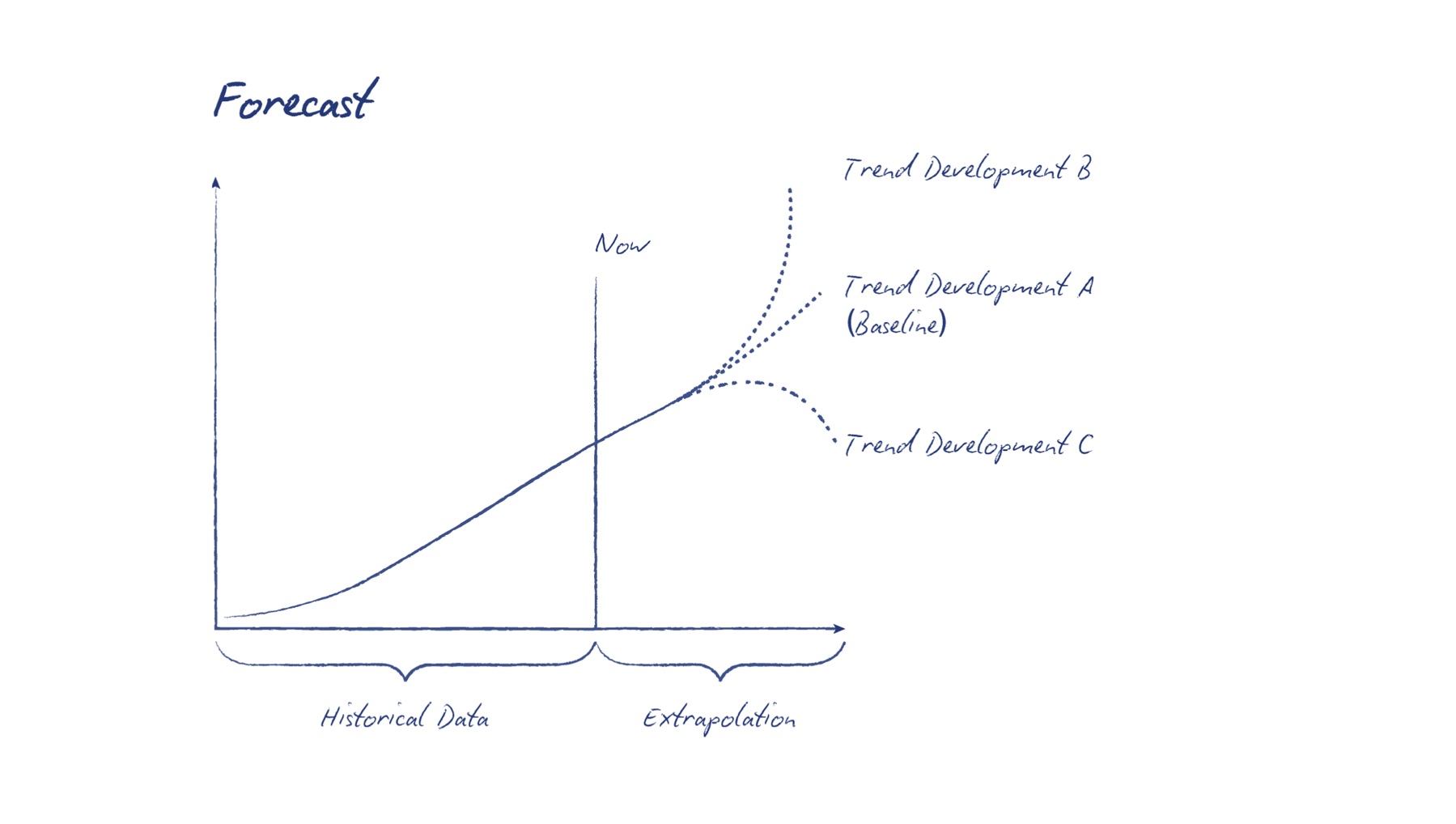
Future forecasting often focuses more on negative scenarios than positive ones. If the weather were always clear, forecasts would not be necessary. As a design futurist, my intention is not to predict catastrophe, but to increase the probability of what I call a positive forecasting error. By confronting people with futures that may feel uncomfortable or even dystopian, we can expand the space in which alternative outcomes become imaginable.
In my view, it helps to distinguish forecasting from foresight. Forecasting is closer to statistical modelling. It works from already visible data and recognisable patterns, and it tries to estimate what is most likely to happen next. Foresight, by contrast, is a process of constructing and exploring futures that have not yet stabilised into data. It is less about getting the future right, and more about deciding which futures are worth preparing for.
In that sense, I treat foresight as an attitude of intervention, a way of reframing prediction itself, while forecasting remains a tool for understanding the present and its trajectories. If a future designer can use foresight to reframe what prediction means, and in doing so increase the likelihood of a positive forecasting error, I would consider that a rare and deeply satisfying outcome.
However, deciding in advance what is dystopian or utopian is not necessarily a responsible position for a future designer. Especially when working with speculative scenarios, we cannot assume that negative problems will always lead to negative outcomes, or that positive conditions will result in positive consequences. The definitions of problem and solution shift depending on perspective, stakeholders, and the margin of forecasting error itself.
Take CLIMATE CHANGE as a familiar example. From a human industrial perspective, climate instability is defined as a crisis, and rightly so. We identify causes, predict worst case scenarios, and attempt to resolve the issue. But if we shift the point of view to another species, or to the planet as a system, the framing becomes less certain. For some organisms, environmental change may represent expansion rather than loss. For the Earth itself, it may simply be another recurring cycle. This does not diminish the urgency of climate action, but it highlights how unstable the notion of a universal problem can be.
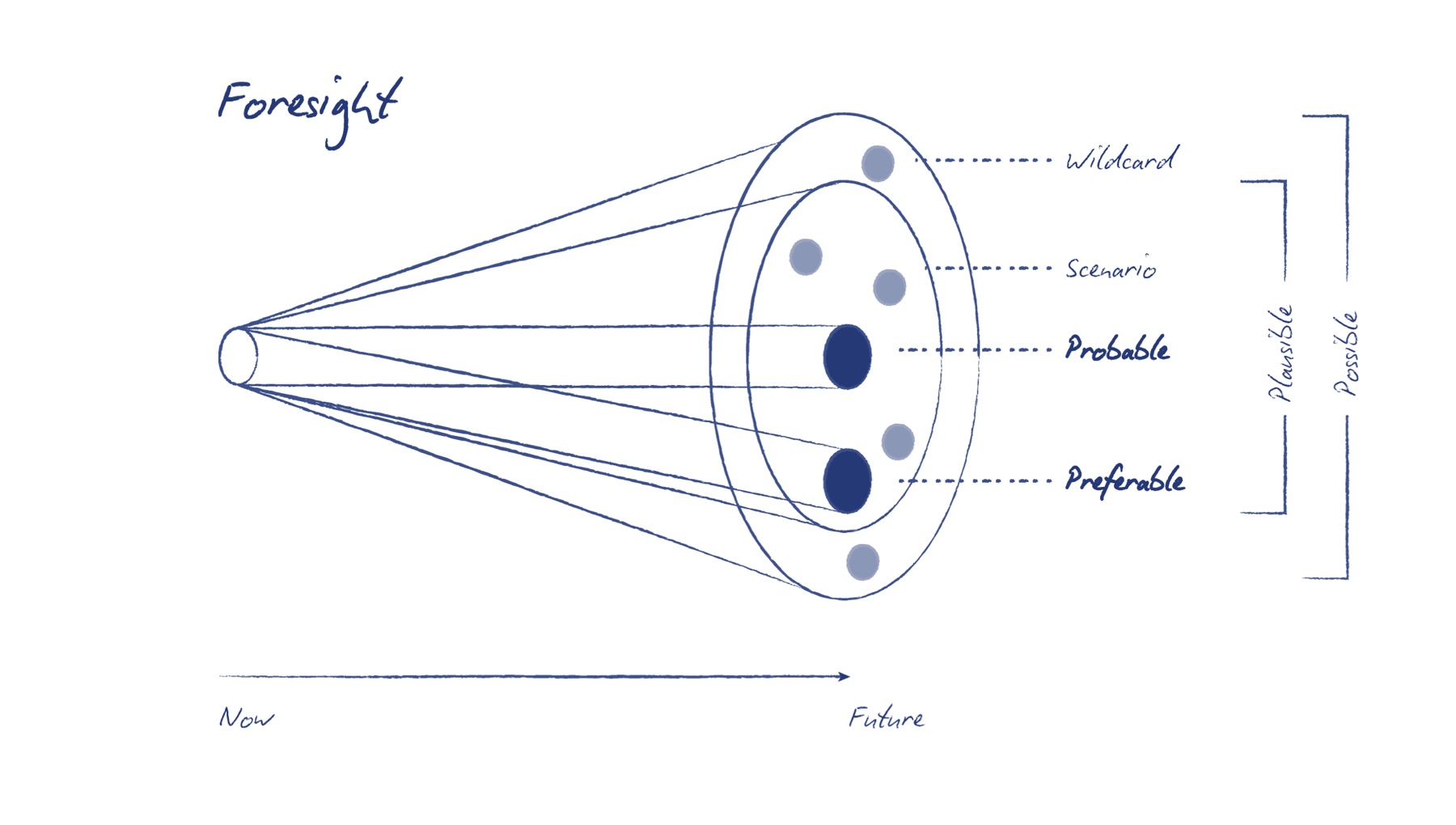
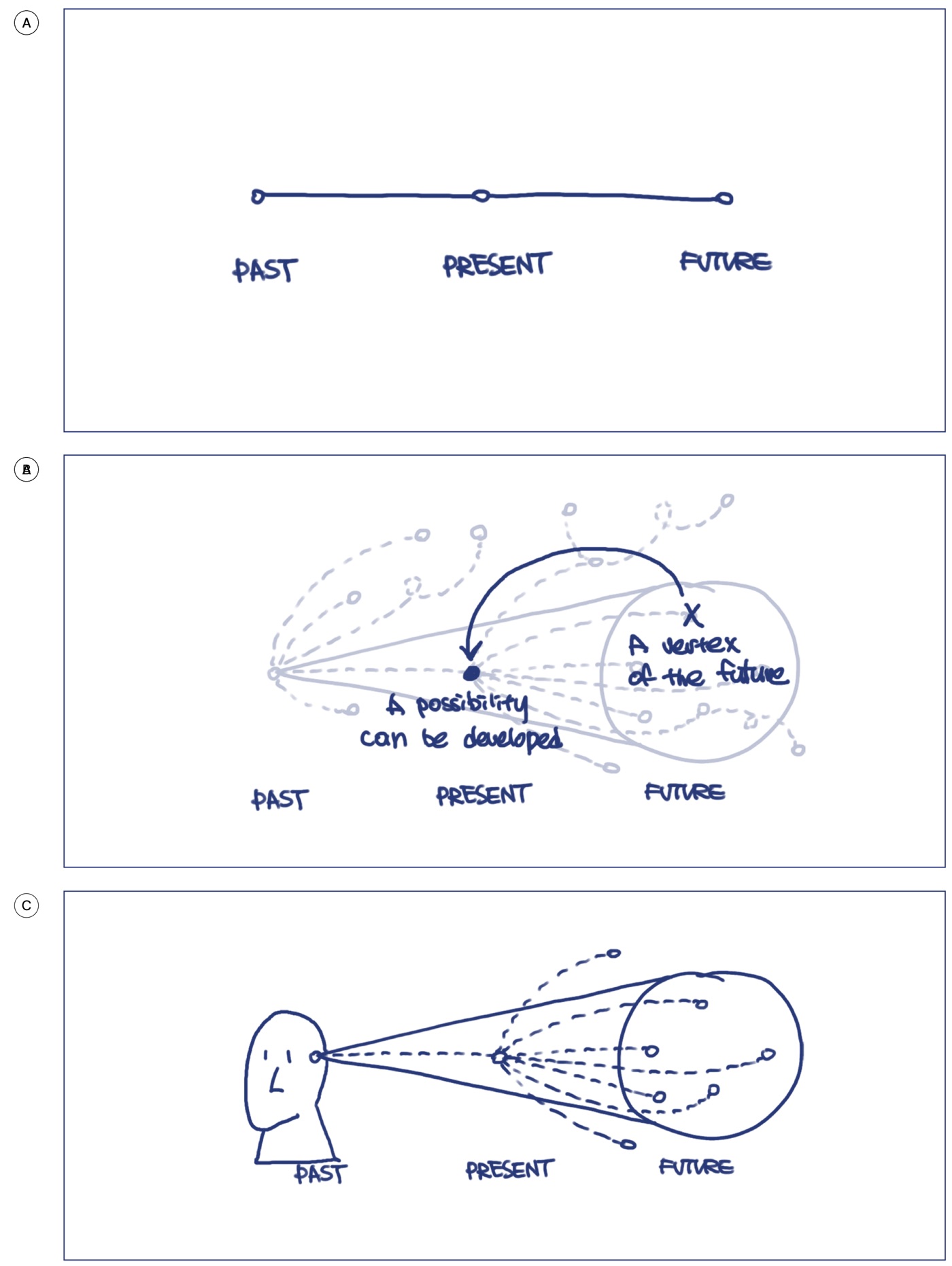
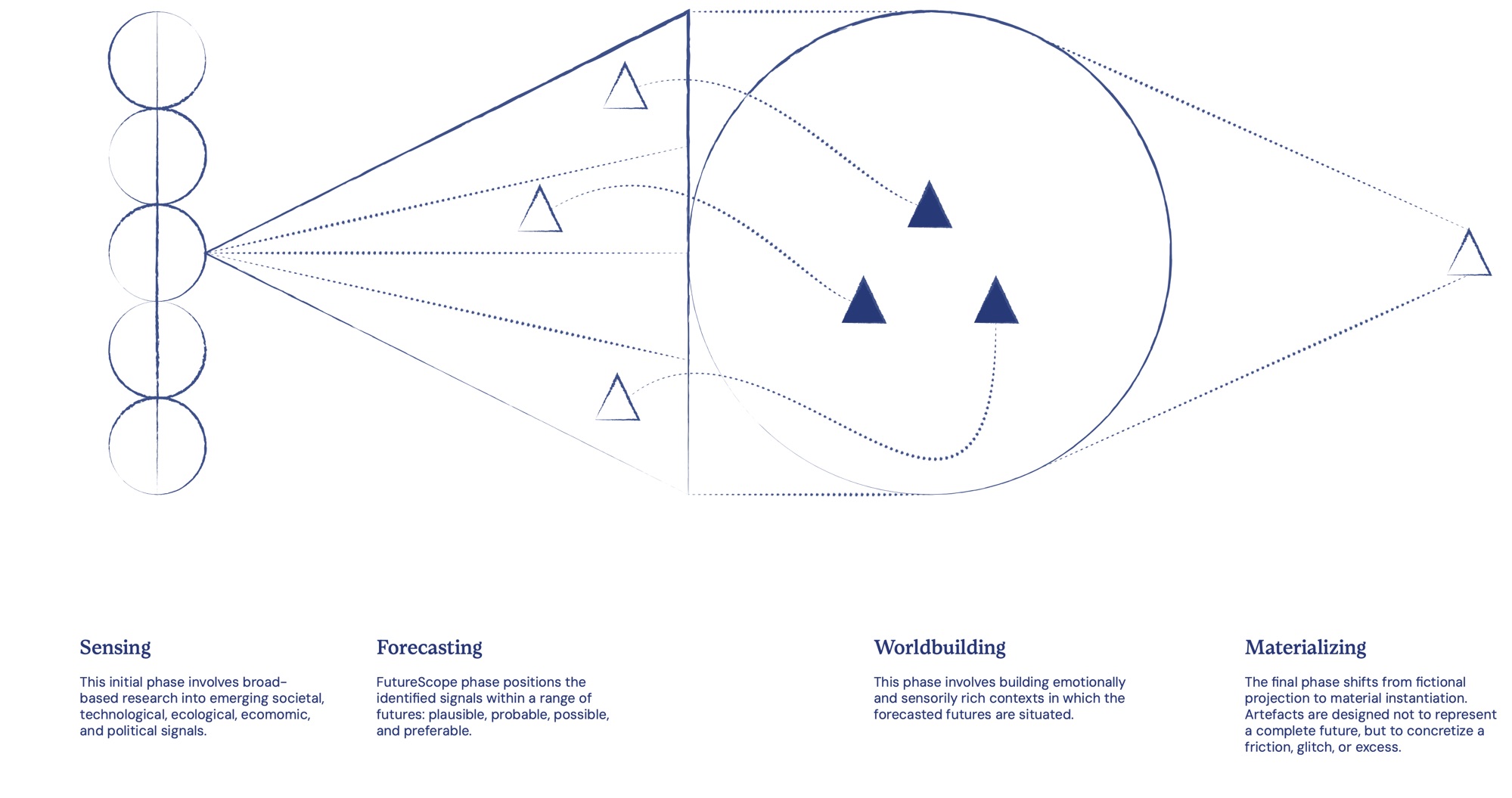
For this reason, defining the future too precisely is rarely productive. What matters more is the ability to analyse emerging signals, construct multiple scenarios, and translate them back into the present using language that people can understand. When this translation happens through visual means, that is where the future designer operates.
In an era shaped by hyperobjects* such as microplastics, AI-driven labour replacement, and declining birth rates, humanity must consider how it can become a better ancestor to future generations. My practice focuses on researching environmental, social, and anthropological signals, then linking seemingly isolated issues into coherent forecasts. Through this process, I aim to propose more sustainable human responses to futures that are already approaching.
3. On Cupidastic 2025
Cupidastic (2025) began with a simple question:
if we can be replaced mentally and physically, are we still human, and what is the last form of humanity we must protect?
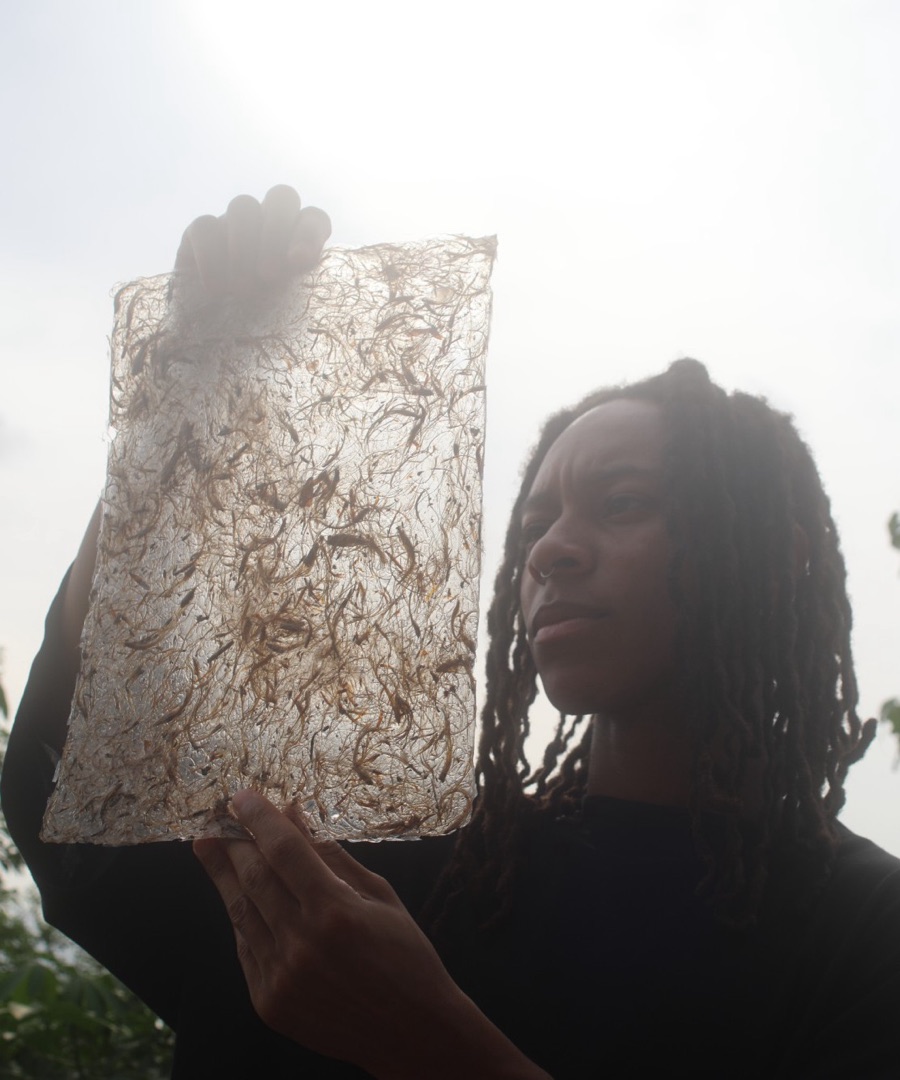
The project began as a personal inquiry into microplastics*. Having been born into an era shaped by plastic, I have benefited from the conveniences of an advanced material culture. Yet I became increasingly uneasy about the biological changes that plastic has already caused, and may continue to cause, within the human body. I wanted to understand this condition more precisely.
Microplastics, however, present a problem that is both vast and unresolved. Their long-term effects remain inconclusive, and the idea of fully controlling them is unrealistic. Rather than attempting to address the issue in its entirety, I chose to translate the smaller, accompanying problems into a design language. The question gradually shifted. Instead of asking how to solve microplastics, I began asking what kind of forecasting is required when the future itself is uncertain.
This led to a more fundamental concern. What should a designer do when confronted with a problem that cannot be resolved within existing design frameworks? How can such a subject be expanded without collapsing into abstraction? The conclusion I arrived at was that the answer lies in a different question: what is the last form of humanity that must not be replaced?
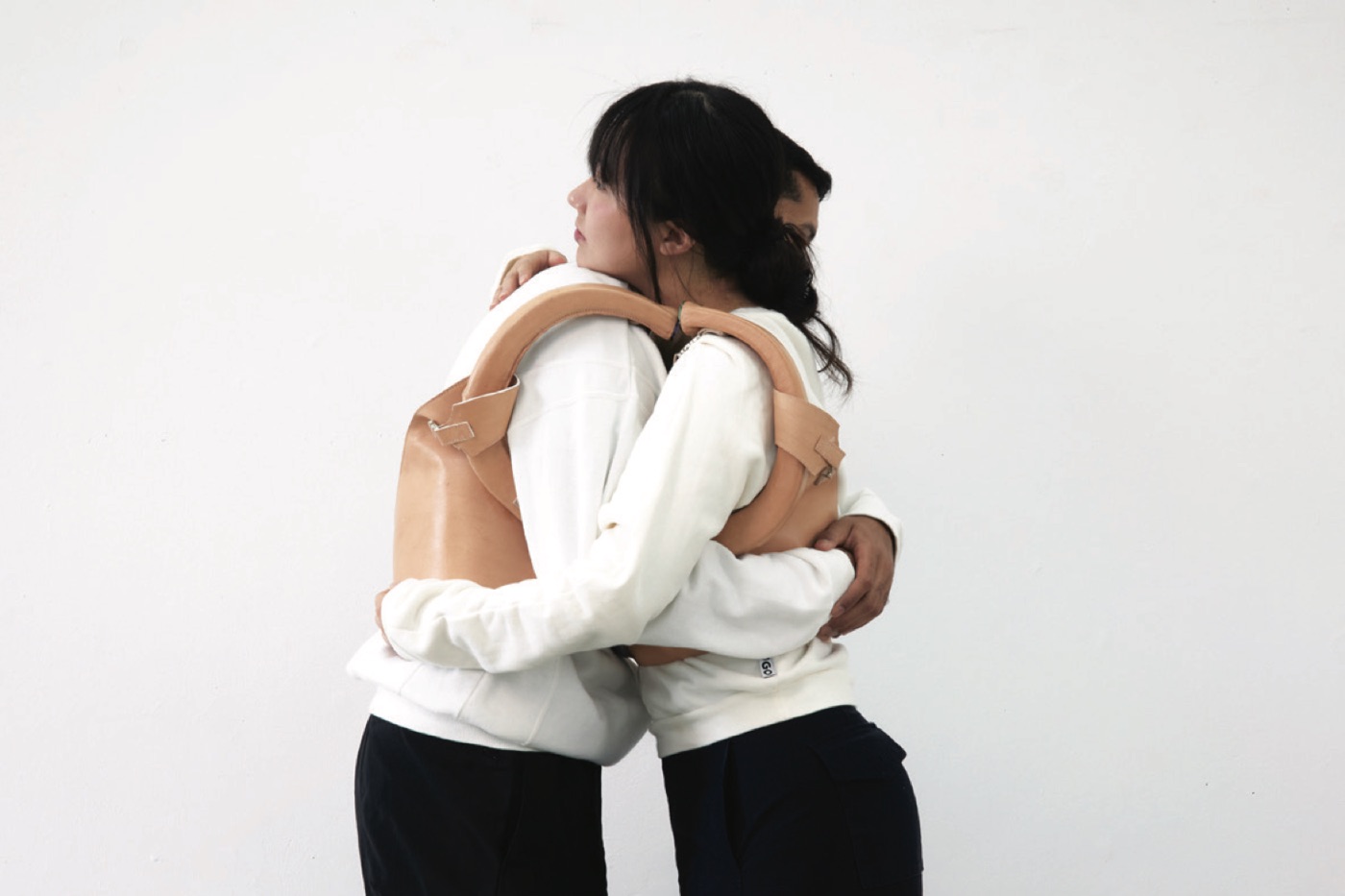
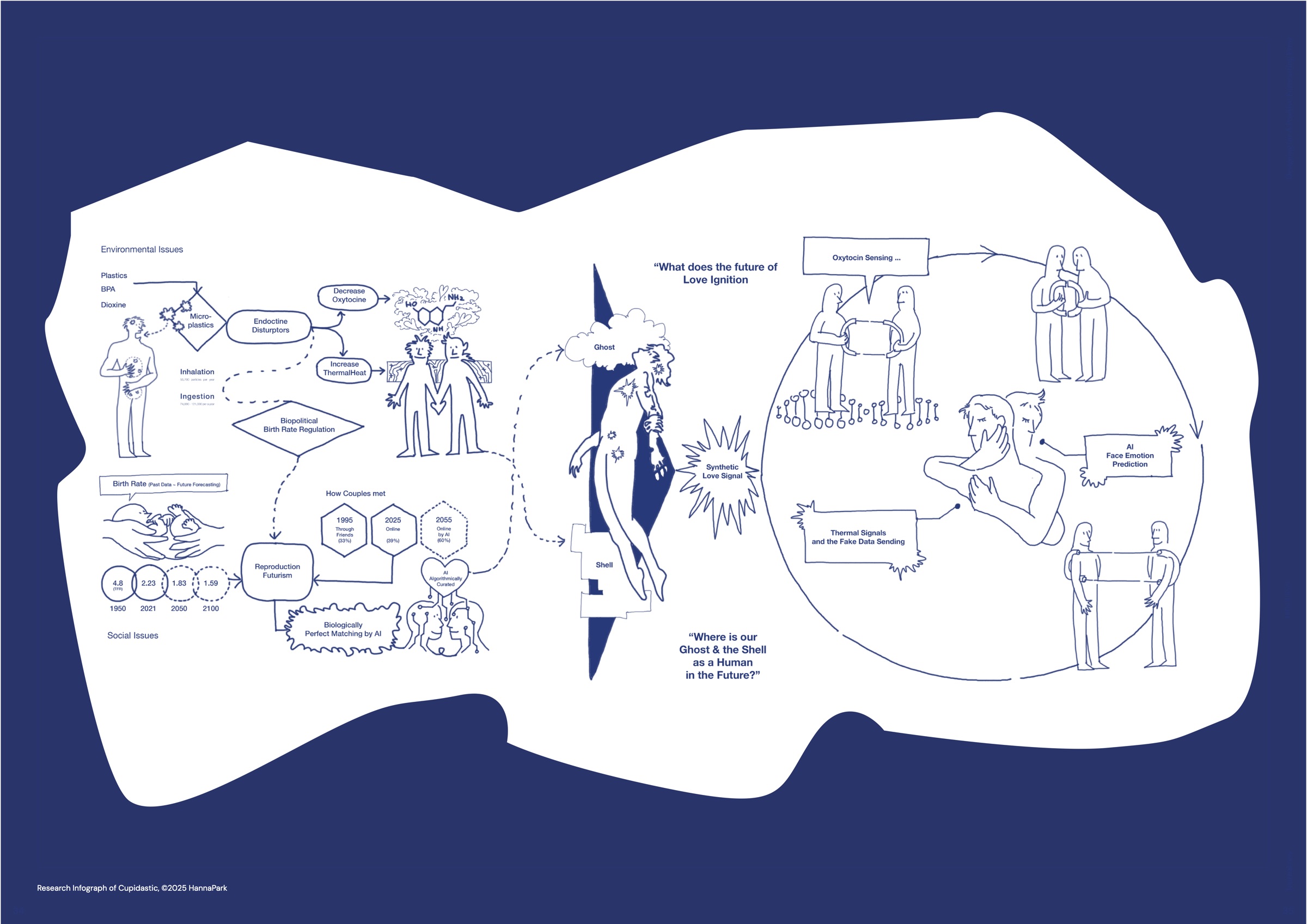
Cupidastic asks whether environmental disruption, specifically hormone interference caused by microplastics, could be reframed as a form of romantic attraction. It is a speculative system that translates invisible concentrations of microplastics in the body into hormonal disruption, visualising the diminishing perception of love signals such as oxytocin.
Within Cupidastic, the body becomes a sensing site. Invisible concentrations of microplastics are treated as a proxy for hormonal disruption, and that disruption is translated into a reduction in the legibility of “love signals”, such as oxytocin. The system is designed to make this shift felt rather than merely stated.
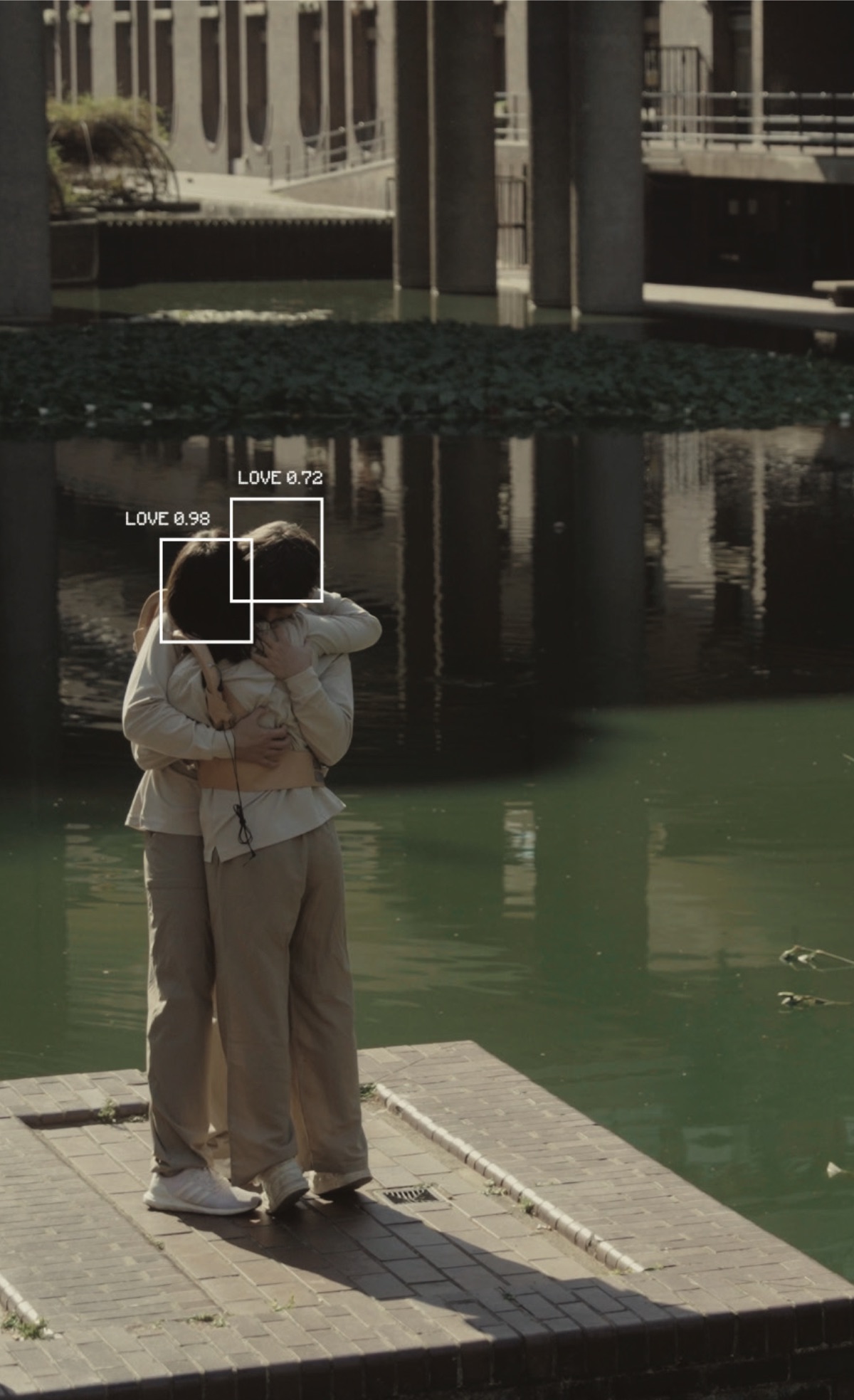
Only after that does the matching layer appear: an AI model proposes partners through rational optimisation, as if intimacy were a problem of efficiency. The contradiction is deliberate. Users are asked to sit between two logics at once, trusting an optimised recommendation while still longing for a spark that cannot be fully converted into data.
The system also includes a way to disturb its own logic. When two users develop intimacy, they can generate synthetic thermographic traces linked to their encounter. These traces are not “better data” in a technical sense. They are data that the system cannot fully interpret. For the AI, the output is noisy and effectively illegible; for the users, it functions as a private record of something shared.
This is the moment where unpredictability returns. In a system built to remove variables, the users reintroduce themselves as variables to one another.
In that sense, Cupidastic proposes a positive forecasting error. Even if environmental interference weakens hormonal control, and even if algorithms begin shaping partner selection, the act of making oneself unreadable to optimisation preserves something that cannot be outsourced.
Unlike machines, humans cannot hide love or sneezes. In that sense, our vulnerability is both a curse and a gift.
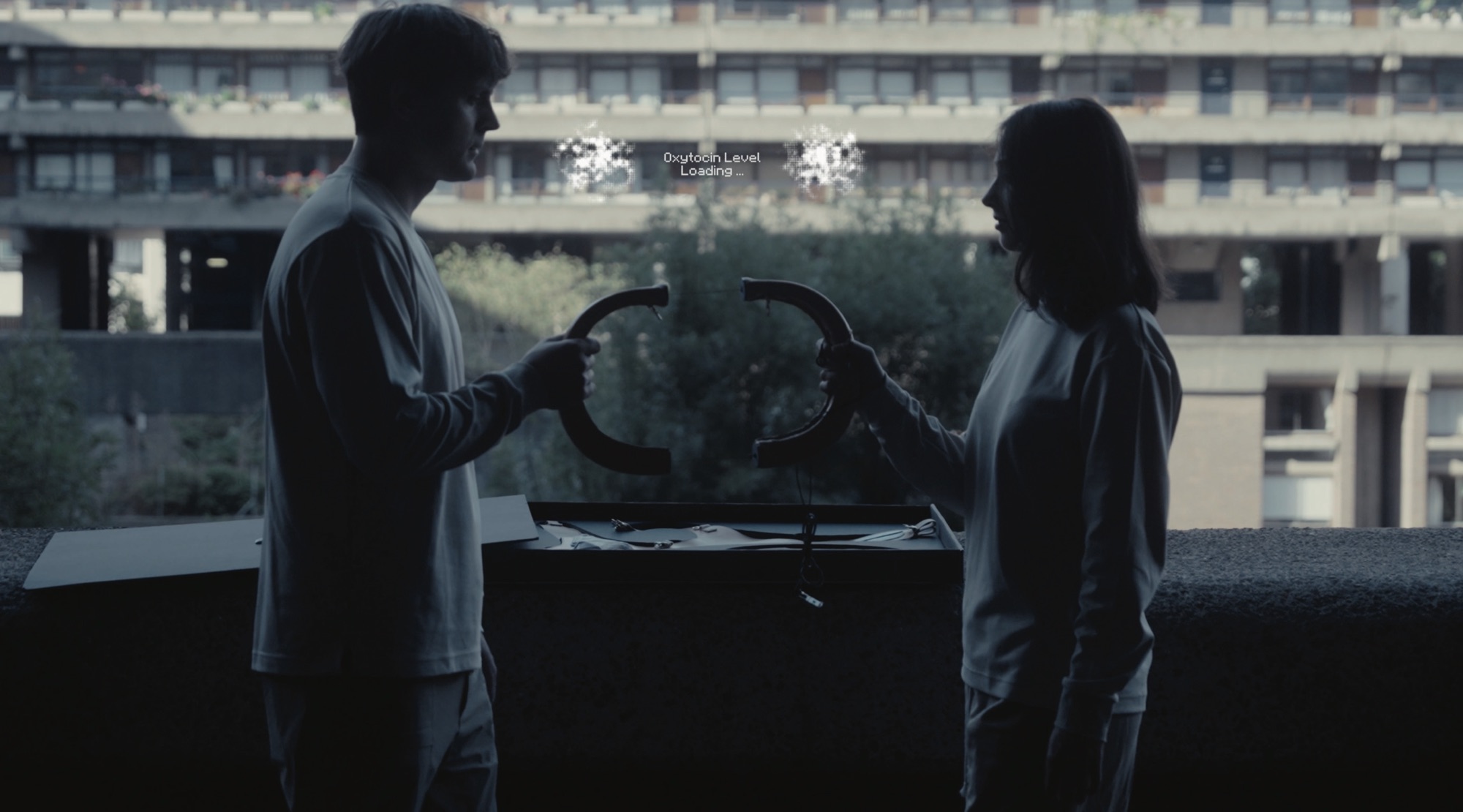
It is not difficult to imagine a scenario in which an environmental factor created by humans, such as microplastics, induces biological changes within the body. In such a future, even the capacity to recognize or interpret love might become mediated by artificial intelligence. The possibility that we may one day rely on algorithms to determine whether we love someone is, perhaps, something we all hope remains a forecasting error.
Despite the environmental and technological transformations we face, there are values that feel fundamentally human and worth preserving. Among them, the right to love another person stands out as something we would hesitate to relinquish. What began as a question about environmental disruption evolved into a broader, more philosophical inquiry. If humans are replaced, both mentally and physically, what remains of humanity?
To explore this, I approached the project through a range of research methods, testing different hypotheses across environmental, technological, and anthropological domains.
At this point, it is worth briefly addressing a familiar method within future-oriented design. Speculative design* is often used when constructing future scenarios, particularly at the stage of building hypotheses. It is highly effective in expanding ideas and amplifying the conditions of a problem, allowing designers to create more vivid and memorable projections.
However, speculation alone is not enough. A story such as Santa’s sleigh may capture attention, but without sufficient narrative grounding, it cannot sustain belief. A future that exists only as an abstract exaggeration risks losing its persuasive force. If no one continues to believe in the story, its emotional and cultural value disappears.
For this reason, when communicating an expanded future, one that still exists largely as conjecture, a clear and structured build-up of logic becomes essential. The audience must be able to follow how the scenario emerges, not simply observe its outcome.
This project operates on the assumption that speculative design gains greater persuasive power when it is grounded in scientific reasoning. Based on this, I developed and applied a hybrid methodology.
To make an otherwise non-existent future perceptible, the project introduces two key devices. The first is scientific research based on existing data. The second is an experiential prototype that operates using real data.
The central challenge of the project was to construct a bridge between these tangible elements and the speculative future they are intended to represent. The future designer does not exist to decide what the future should be. They exist to make room for futures that are still undecided. By resisting premature conclusions and visualising uncertainty itself, future design keeps the possibility of human agency alive.
The future designer does not exist to decide what the future should be. They exist to make room for futures that are still undecided. By resisting premature conclusions and visualising uncertainty itself, future design keeps the possibility of human agency alive.
What matters here is not the plausibility of a single prediction, but the clarity of what the scenario reveals about agency, vulnerability, and what we might still refuse to outsource.
4. Closing
Closing, then, is less a conclusion than a commitment. If future design has a responsibility, it is to hold uncertainty long enough for meaningful choices to remain possible.
Ultimately, the future designer works through foresight. Rather than treating the future as something to be predicted from existing data, foresight asks what futures are worth imagining, preparing for, and arguing about. It is a practice of reframing: constructing and exploring futures that have not yet stabilised into evidence, then translating them back into the present as choices, responsibilities, and lived implications.
This is why I return to the idea of a ‘positive forecasting error’. Like UNICEF, whose long-term ambition is a world in which its work is no longer needed, a positive forecasting error points towards a future where the warning becomes unnecessary. The aim is not accuracy for its own sake, but intervention. A difficult outcome is projected, recognised early, and then displaced through action, policy, or cultural change.
In that case, the forecast “FAILS” in the most productive way: it succeeds in helping to prevent what it described.
Cupidastic is one attempt to make that commitment tangible, by treating love not as a sentiment to be optimised, but as a human right that becomes fragile under environmental and technological pressure.